Hello, my name is Elisabeth DeRichmond, and my birthdate is October twenty-seven nineteen77.
Five years ago, my life looked very different. I was severely overweight and living with debilitating lower back pain. I relied on a cane and, on harder days, a walker, just to get from one room to the next. I refused to take narcotics for the pain — but no one warned me about the dangers of a common alternative.
I turned to naproxen. You probably know it better as Aleve. I was taking it constantly — every day, sometimes multiple times a day — just trying to get through. It helped take the edge off, but it wasn’t a solution. The real solution, I eventually realized, was losing the weight.
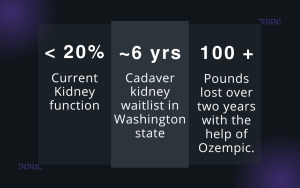
So I did. Over the course of two years, I lost more than 100 pounds. My back pain faded. By most measures, it was a triumph. But while I was focused on healing in one way, I was unknowingly causing irreversible damage in another.
“I may not look sick. But the reality is that I am — and my kidneys are running out of time.”
Naproxen is a nonsteroidal anti-inflammatory drug (NSAID), and when taken in large amounts over extended periods, it can cause serious kidney damage. I didn’t know that. By the time my kidneys were evaluated, I was already at stage 3 chronic kidney disease. And I’ve been watching my function decline ever since.
Living with kidney disease is not just about the kidneys. It causes anemia, which means my body is chronically exhausted. I often need two or three hours of sleep in the middle of the day — not because I want to, but because my body simply demands it. That fatigue has made it impossible to hold traditional employment. I can’t show up and perform at a full-time job when I can barely stay awake.
On top of kidney disease, I also live with epilepsy and tremors. My epilepsy is managed with medication, and for that I’m grateful. The tremors are another story — they’re unpredictable and beyond my control. Some days I manage. Other days it’s deeply frustrating to feel like a stranger in my own body.
There is only one cure for kidney failure: a transplant. I have two paths forward — a kidney from a cadaver donor, or a living donor. The cadaver waitlist in Washington state is approximately six years long. A living donor, once cleared by the transplant team, can donate much sooner. I’m not on dialysis yet, but I’ll start at the beginning of December.
Could you be my living donor?
If you’re willing to consider this, first — thank you. From the bottom of my heart, thank you for even reading this far. Here is what you’d need to know about the initial basic requirements:
- You must have type O blood
- No personal history of kidney, pancreas, or liver disease
- You would need to be tested for genetic compatibility by the transplant team
If you qualify and choose to donate, I want you to know: I have a place for you to stay before, during, and after your surgery. And there is no cost to you — my insurance covers all donor-related medical expenses. Click on the link below.
Even if donation isn’t right for you, please consider sharing my story. Every person who learns about my situation is another chance at finding the person who can save my life.

A word about naproxen and kidney health
Naproxen — sold as Aleve — can cause serious, permanent kidney damage when taken frequently over a long period. If you are managing chronic pain, please talk to your doctor about alternatives. What happened to me can happen to anyone. Please protect your kidneys.
Thank you for reading. Thank you for caring. And thank you for sharing.


